Login
Login



- What are catalytic inks and why are they important in fuel cells and electrolyzers
- What is meant by the Mixing technology for producing catalytic inks
- What materials are used in catalytic ink production
- Why is producing catalytic inks at an industrial scale technically challenging
- How does inline dispersion technology support the mixing technology for catalytic inks
- Why is particle dispersion critical for catalytic ink performance
- How do safety and automation influence the Mixing technology
- How does the mixing technology improve scalability from research to mass production
- How does catalytic ink quality affect membrane electrode assembly performance
- What role does catalytic ink production play in the hydrogen economy
What are catalytic inks and why are they important in fuel cells and electrolyzers
Catalytic inks are specialized mixtures used to form the catalyst layer in membrane electrode assemblies for fuel cells and proton exchange membrane electrolyzers. These inks contain finely dispersed precious metal catalysts such as platinum or iridium, a carbon carrier for electrical conductivity, and an ionomer that transports protons and binds the layer together.
Their importance lies in their direct role in enabling electrochemical reactions. The quality of catalytic inks determines how efficiently electrons and protons move within the system. A well formulated catalytic ink improves reaction speed, energy efficiency, and long term durability of fuel cells and electrolyzers used in hydrogen production and clean energy systems.
 Compare
 Add to list
What is meant by the Mixing technology for producing catalytic inks
The Mixing technology refers to the advanced process of transferring multiple complex materials into a stable, homogeneous catalytic ink using controlled inline dispersion technology. This method allows solid powders, liquids, and reactive components to be mixed continuously under precise shear conditions.
This technique ensures that catalyst particles remain finely dispersed while preventing agglomeration. It also allows flammable alcohols and corrosive ionomer solutions to be handled safely in an industrial environment. The result is a consistent, scalable, and performance optimized catalytic ink suitable for mass production.
What materials are used in catalytic ink production
Catalytic ink formulation is based on several critical components working together:
- Precious metal catalysts such as platinum or iridium that drive electrochemical reactions
- Carbon support materials that conduct electrons efficiently
- Ionomer based on perfluorosulphonic acid that enables proton transport and serves as a binder
- Alcohol based solvents that help disperse the solid components uniformly
Each of these materials must be precisely balanced. Any inconsistency directly impacts energy conversion efficiency, coating quality, and final system performance.
Why is producing catalytic inks at an industrial scale technically challenging
Producing catalytic inks on an industrial scale is highly demanding due to material sensitivity, safety risks, and the need for absolute uniformity. The combination of fine carbon powders, reactive catalysts, flammable alcohols, and corrosive ionomer solutions creates explosion protection challenges.
In addition to safety, maintaining consistent particle size distribution across large batch volumes is difficult. Unlike battery manufacturing, catalytic ink production does not yet follow fully standardized large scale production methods. As stated in the document, transferring lab scale recipes to high rate industrial production requires complex technical solutions and a high degree of process reliability.

How does inline dispersion technology support the mixing technology for catalytic inks
Inline dispersion technology plays a central role in enabling efficient, safe, and scalable catalytic ink production. The rotor and stator system creates adjustable shear forces that adapt to different viscosities and material types.
Powders and solid catalysts are mixed directly in the high shear zone during processing. This prevents lump formation and ensures uniform mixing. The technology also ensures that every particle is evenly distributed, which is essential for consistent electrode coating and optimal catalytic performance.
Why is particle dispersion critical for catalytic ink performance
Catalyst materials are expensive and their performance depends heavily on how well they are dispersed. When particles are finely and uniformly distributed, the available surface area for electrochemical reactions increases significantly.
This improves both electron conduction through the carbon structure and proton conduction through the ionomer. Poor dispersion leads to reduced reaction efficiency, lower hydrogen production rates, and shorter component lifespan. The document emphasizes that fine dispersion guarantees high electron and proton conduction.
How do safety and automation influence the Mixing technology
Safety and automation are fundamental elements of modern catalytic ink production. Automated dosing of liquid components ensures precise control over mix ratios while inert addition of sensitive catalyst materials reduces explosion risks.
The systems described also support processing of high viscosity mixtures and allow optimized residual emptying. After each production cycle, automated cleaning in place systems thoroughly clean the equipment. This not only improves operational efficiency but also eliminates contamination risks between production batches.
How does the mixing technology improve scalability from research to mass production
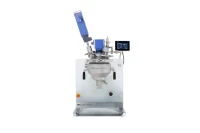
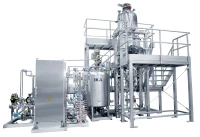
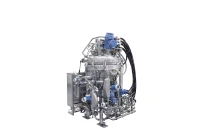
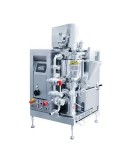
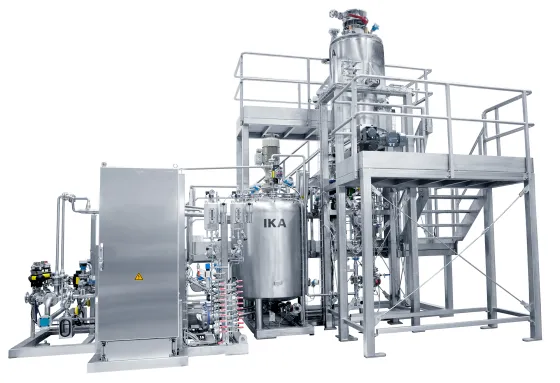
The mixing technology enables seamless transition from laboratory research to industrial scale production. The document illustrates scalable systems ranging from small 2 liter research units to large 4000 liter production plants.
This allows manufacturers to validate ink formulations at small scale and then directly translate the same process parameters into large volume production without compromising quality. Such scalability is essential for meeting the growing demand for hydrogen production technologies worldwide.

How does catalytic ink quality affect membrane electrode assembly performance
The membrane electrode assembly is the core functional unit in fuel cells and electrolyzers. The electrode layer produced from catalytic ink determines:
- Reaction efficiency
- Electrical and proton conductivity
- Mechanical stability of the layer
- Long term operational reliability
If the catalytic ink lacks homogeneity, the entire fuel cell system suffers from reduced efficiency, uneven current distribution, and premature failure.
What role does catalytic ink production play in the hydrogen economy
Hydrogen demand is forecasted to rise dramatically by 2030, requiring massive expansion in electrolyzer manufacturing. Catalytic ink production directly supports this scale up by enabling high performance membrane electrode assemblies to be produced efficiently.
Since electrolyzers rely on catalyst layers for converting electricity into hydrogen, the mixing technology for producing catalytic inks becomes a strategic enabler for the global hydrogen economy, renewable energy storage, and climate neutral fuel production.